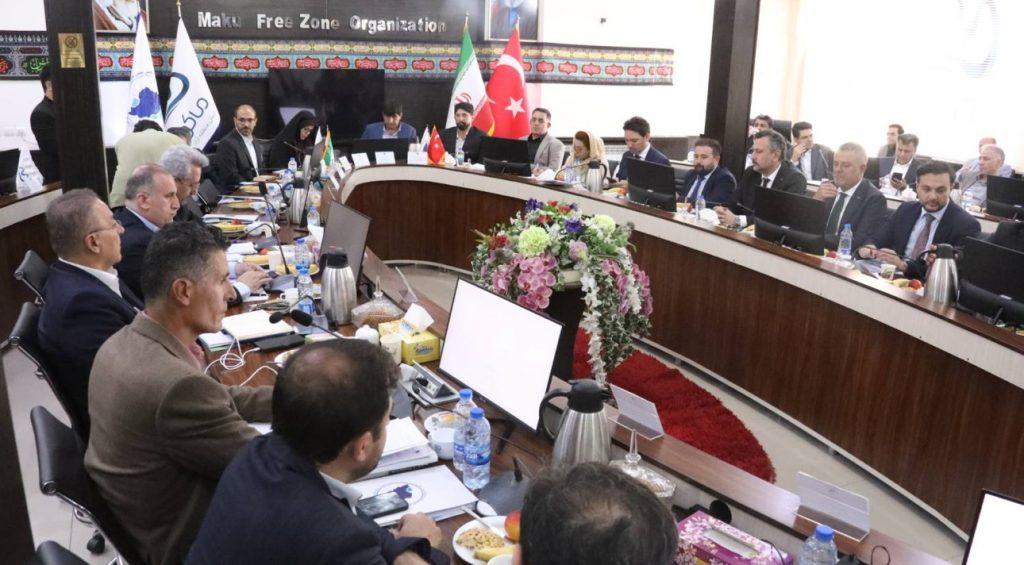
The joint meeting of the international transport associations of Iran and Türkiye was held in the presence of officials from the Maku Free Zone, the Governor of Maku, and representatives of international transport organizations from both countries. During the meeting, the participants discussed the major challenges and practical solutions for expanding transport and trade cooperation between Iran and Türkiye.
Facilitating transit and trade flows and identifying practical solutions to overcome existing challenges were among the key issues discussed. Representatives from both sides, referring to the strategic role of the Bazargan border in trade and transit between Iran, Türkiye, and Europe, emphasized the need for implementing practical measures to reduce truck waiting times and facilitate the movement of commercial vehicles.
The meeting stressed that drivers should not be required to wait for extended periods to obtain a crossing slot and pass through the border. The participants called for appropriate measures to be adopted to significantly reduce the time trucks spend waiting at the border.
The reopening of the Sarısu Border Market was another key demand raised by representatives of both countries. Participants emphasized the need to reactivate the market in order to expand commercial exchanges and facilitate cross-border movement.
During the meeting, participants also referred to the difficult circumstances resulting from the war and recent crises, noting that appropriate measures had prevented any serious disruption to transit and trade flows through the region. The continued operation of commercial and transport activities was described as evidence of the strategic importance and substantial capacity of this route.
According to statistics presented at the meeting, transit activity has increased by 46 percent over the past three months, with more than one million transit movements recorded. This growth further demonstrates the significant potential of the Maku Free Zone and the Bazargan border to strengthen Iran’s role in international transport corridors.
The Governor of Maku also emphasized the need to strengthen the region’s infrastructure, stating that the development of transport, customs, and logistics infrastructure must keep pace with the growth of trade and transit in order to accommodate the increasing volume of commercial vehicle traffic.
Dastgerdi, Acting Deputy for Economic Affairs and Investment of the Maku Free Zone Organization, referring to the volume of trade between Iran and Türkiye, said that bilateral trade had amounted to approximately USD 5.5 billion over the past year, a significant portion of which had been conducted through the Bazargan border.
Referring to the capacities of the Maku Free Zone, he added that specialized logistics and transport companies are based in the zone and that the area has the potential to become one of the major logistics and transit service hubs along the Iran–Türkiye route.
Dastgerdi also identified the establishment of a joint financial exchange center as one of the region’s key demands, stating that the creation of appropriate financial mechanisms could play an effective role in facilitating commercial transactions between economic operators in the two countries.
The meeting also emphasized the need to increase the capacity for truck crossings. Representatives from both sides called for the daily truck-crossing capacity to be increased from approximately 300 vehicles to 600 vehicles.
At the conclusion of the meeting, representatives of the international transport associations of Iran and Türkiye stressed the need for closer cooperation between private-sector organizations and the executive authorities of the two countries. They identified the facilitation of transit, reduction of truck waiting times, strengthening of border infrastructure, increasing vehicle-crossing capacity, and reopening of the Sarısu Border Market as among the most important requirements for expanding trade and transit between Iran and Türkiye.
The meeting was held as part of efforts to strengthen transport and trade cooperation between the two countries, with the aim of turning the capacities of the Bazargan border and the Maku Free Zone into a practical operational advantage along international transport corridors.